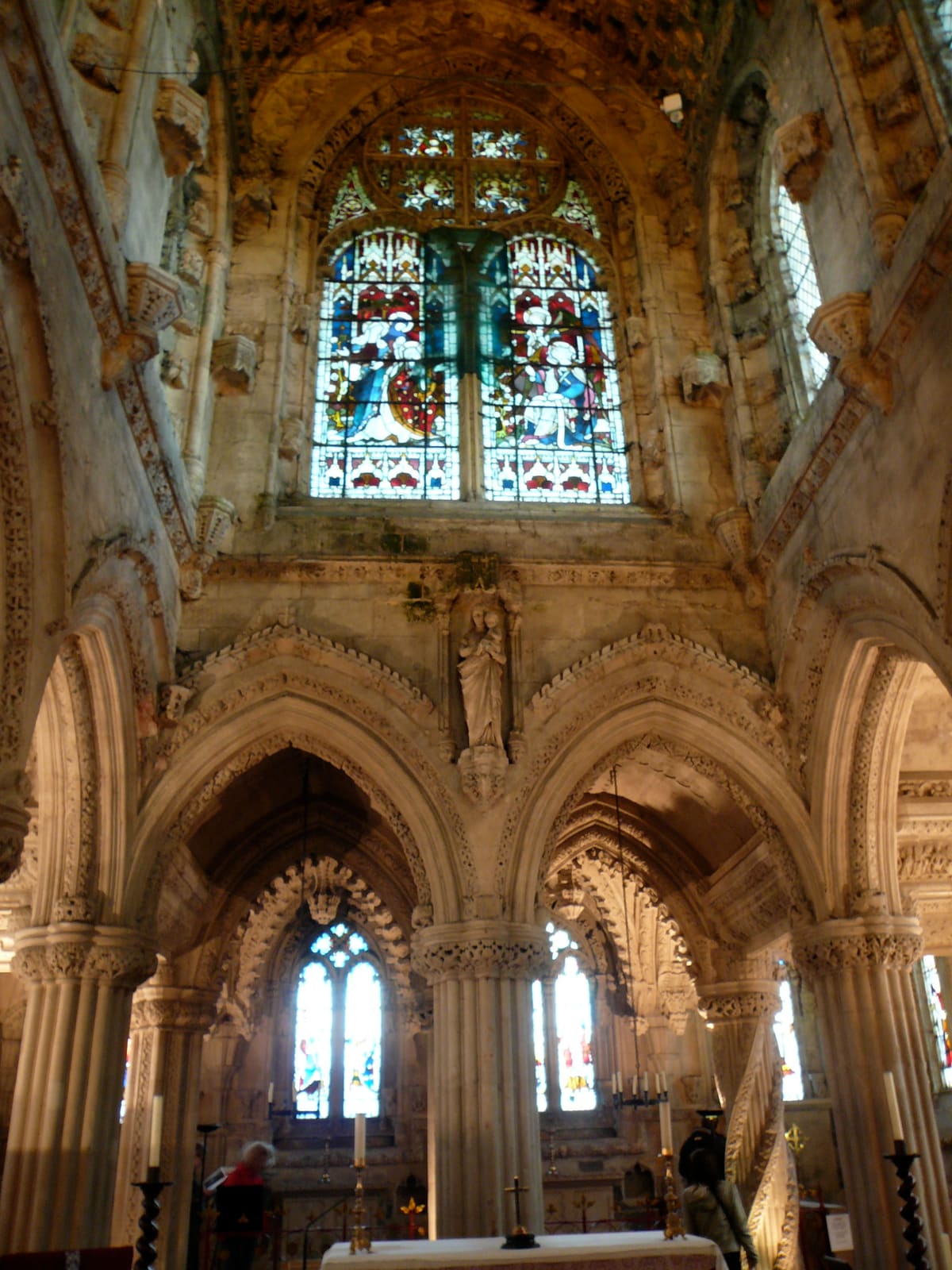
 Thomas Duesing / Wikimedia Commons, CC BY 2.0
- Established Peer-reviewed or mainstream consensus: the claim is as settled as archaeology gets.
- Suggestive Plausible and evidence-backed, but limited, evolving, or not yet mainstream.
- Contested Disputed among researchers, or popular-press overreach of what the evidence actually shows.
Just south of Edinburgh stands Rosslyn Chapel, ground broken in 1446 and never finished. It is not large. What makes it extraordinary is that almost every surface inside is carved, one of the densest programmes of stone carving in Europe, packed with foliage, figures, biblical scenes and motifs that nobody has fully explained. Rosslyn keeps its secrets the honest way: by displaying all of them at once.
The building and its history
Rosslyn Chapel was founded by William Sinclair, first Earl of Orkney and Caithness. Construction began in 1456 and continued until roughly 1486, when the original ambitious plan was abandoned and the building was left incomplete. What was finished contains approximately 213 carved stone cubes, extensive figurative sculpture, and a programme of decoration that has occupied researchers, enthusiasts, and novelists for five hundred years. Established
Rosslyn Chapel Trust – rosslynchapel.com; historical overview – Wikipedia.
The Apprentice Pillar and the murder legend
The chapel’s most celebrated feature, the Apprentice Pillar, is a twisted column of exceptional intricacy. It comes wrapped in a legend: the master mason, returning from Rome to find his apprentice had completed the pillar in his absence, killed the young man in a jealous rage. The carved heads of a man, a woman and a wounded young man on the wall nearby are said to represent the mason, his wife and the apprentice. Suggestive The story is documented legend rather than verifiable historical record, but it is old, specific and fits the carving. The pillar is real. Whether the murder is, nobody now knows.
The music in the stones: the cube theory
More than 213 small stone blocks project from the chapel’s arches, each carved with a distinct geometric pattern. In 2007, Thomas and Stuart Mitchell proposed that the patterns correspond to Chladni figures, the shapes that appear in sand or powder sprinkled on a vibrating surface at specific frequencies. Their claim was that reading the cubes in sequence produced a musical piece they called the Rosslyn Motet. Contested
Mitchell proposal – Wikinews (2007); rebuttal (Slate, 2011, citing Prof. Warwick Edwards, Glasgow) – Slate.
The theory has been examined and found to rest on a series of shaky assumptions, including that the Chladni figure interpretation of the carvings is correct, that the reading order is established, and that some of the cubes that fell and were replaced during restoration were put back in their original positions. Music scholar Warwick Edwards of the University of Glasgow was among those who found the theory unconvincing. The cubes are real, their patterns are real, and the idea that a medieval building might be a frozen score written in stone for anyone patient enough to read it remains one of the more evocative contested theories in architectural history.
The maize and aloe carvings
Among the plant carvings at Rosslyn are some that have been said to resemble New World maize and aloe, plants that would not have been known in Scotland in the 1450s. The claim, if true, would have significant implications for our understanding of pre-Columbian contact or knowledge. A 2021 peer-reviewed study in the botanical journal Bradleya concluded that the carvings are not Aloe vera but rather abstract decorative features without a specific botanical referent. Contested
Thomson (2021), Bradleya 39: 265–270 – BioOne.
The Da Vinci Code effect: a real-world case study in fiction and footfall
In 2003, Dan Brown’s novel The Da Vinci Code made Rosslyn Chapel its climactic setting. The film followed in 2006. The impact on the chapel was measurable and documented: visitor numbers rose from approximately 38,000 per year before the novel to around 176,000 in the years after. A 2023–24 Trust survey of 6,677 visitors found that 49 percent cited the novel or film as the reason for their visit. Established The interior of the chapel was used during filming in September 2005.
Rosslyn Chapel Trust, “The Da Vinci Code at Rosslyn” – rosslynchapel.com.
The Rosslyn Chapel Trust presents this straightforwardly on their own website, which is an unusual act of institutional honesty: a building that would be significantly less visited were it not for a work of fiction that found the real building just credible enough to carry the weight of the story. Rosslyn is genuinely mysterious, genuinely dense with carving and competing theory, genuinely unfinished. The fiction found a building that was already almost too convenient.
Where the real places end and the story begins
The chapel, the carvings, the cube theory, the builder’s legend, the Da Vinci Code connection: all real, all on the record, and the building is open to visit.
Rosslyn is the last place on this trail, and it earns its position at the end: it is a building that has spent five hundred years accumulating theory, where the density of carving makes every explanation feel simultaneously possible and insufficient. Stolen Genesis is another novel that found Rosslyn an irresistible place to visit. What the characters find in the novel belongs to the fiction. What was already there is quite enough to be going on with.
You've walked the whole trail
Get the complete Real Places field notes as a PDF now, plus each new site as it drops
All eight sites in one PDF. Take it with you. And as the series continues, each new place surfaces straight to your inbox.
Never shared. Leave any time.← Return to all the real places
Stolen Genesis: Legacy Denied is Book One of the Stolen Genesis series. The locations are real.