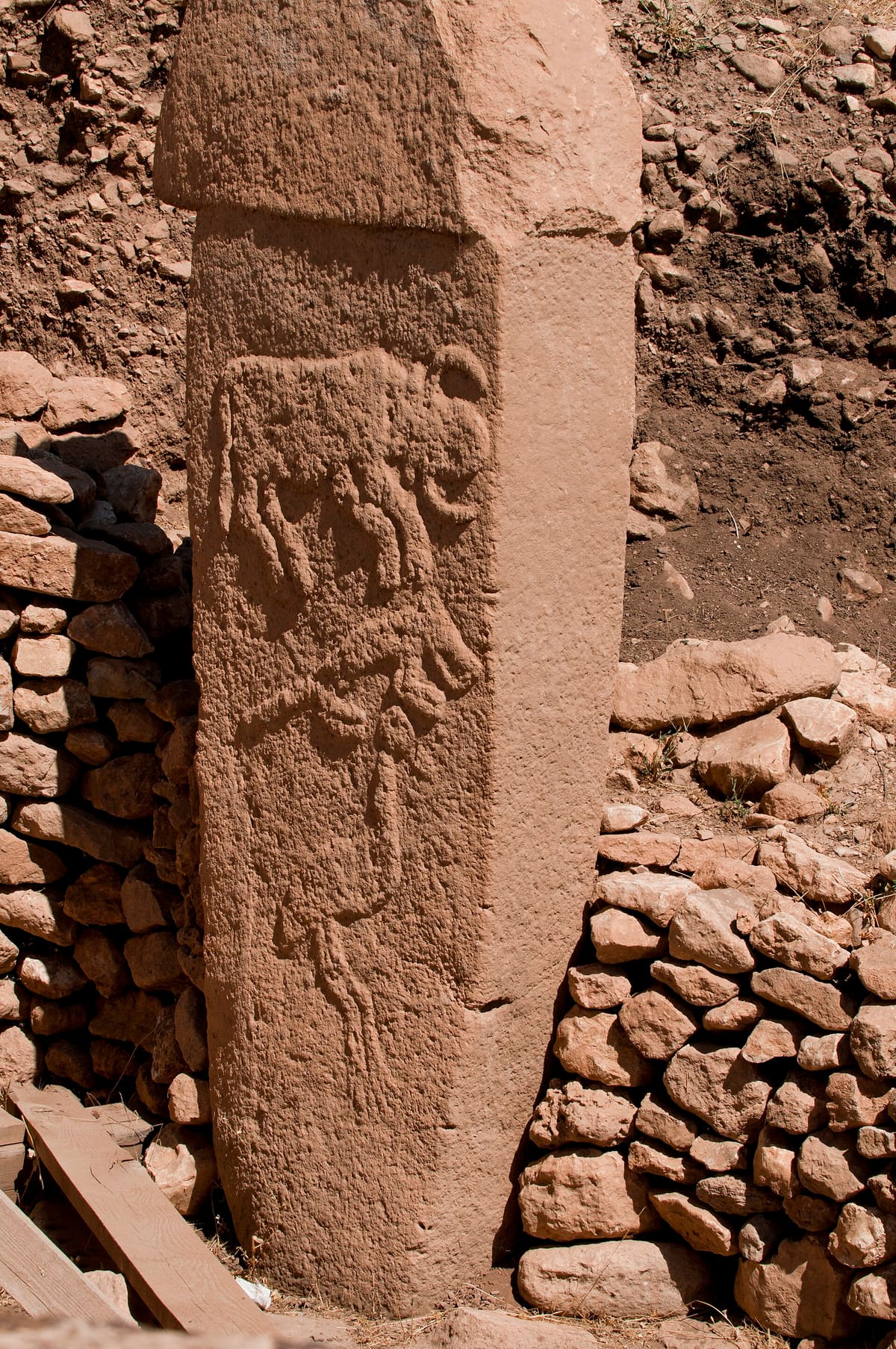
 Teomancimit / Wikimedia Commons, CC BY-SA 3.0
- Established Peer-reviewed or mainstream consensus: the claim is as settled as archaeology gets.
- Suggestive Plausible and evidence-backed, but limited, evolving, or not yet mainstream.
- Contested Disputed among researchers, or popular-press overreach of what the evidence actually shows.
On a dusty ridge in south-eastern Turkey, near the city of Şanlıurfa, there is a hill that should not be there. Beneath it sit rings of carved stone pillars raised more than eleven thousand years ago, by people who had no pottery, no metal tools, no wheel, no writing and, crucially, no farming. By every rule we thought we understood, they should not have been able to build it. They built it anyway. Then, just as deliberately, they buried it.
This is Göbekli Tepe, and its discovery did something almost no find ever does: it forced mainstream historians and archaeologists to rewrite the accepted story of how human civilisation began.
The dates: what we actually know
The oldest layers at Göbekli Tepe date to approximately 9600 BCE, established by AMS radiocarbon dating. Established Enclosure D, the largest and arguably most sophisticated, has been dated to roughly 9745 to 9314 calibrated BCE. Layer III, the deepest and oldest structural layer containing the famous T-pillar enclosures, dates to approximately 9500 to 8800 BCE.
Sources: Dietrich, Heun, Notroff, Schmidt & Zarnkow (2012), Antiquity 86(333) – Cambridge University Press; DAI Tepe Telegrams, "How old is it? Dating Göbekli Tepe" (2016) – dainst.blog; Dietrich et al. (2013), Neo-Lithics – ResearchGate.
To put the age in context: Göbekli Tepe predates Stonehenge by roughly six thousand years and the Great Pyramid of Giza by approximately seven thousand. When the first pillars went up, the last ice age had only just released its grip.
The problem it creates for the textbooks
The accepted model, taught as settled fact for most of the twentieth century, was simple: first, humans learned to farm; farming produced surplus; surplus produced towns; and only then, with people settled and fed, did they have the time and organisation to raise temples. Civilisation was supposed to be the reward for agriculture.
Göbekli Tepe runs that sequence in reverse. Here is monumental, organised, symbolic architecture built by hunter-gatherers thousands of years before farming, before the very prerequisite that was supposed to make it possible. Established
The German archaeologist Klaus Schmidt, who excavated the site from 1995 until his death in 2014, drew the implication plainly:
First came the temple, then the city.
The argument now widely discussed in mainstream archaeology is that the urge to gather, to build shared monuments, to do something together in one place, may have been what pushed scattered foragers toward agriculture, not the other way around. The communal labour that Göbekli Tepe required may have driven the need for reliable food supply, rather than depending on it.
What is actually carved into the stone
The pillars are extraordinary. The largest stand over five metres tall and weigh ten to fifteen tonnes, T-shaped limestone monoliths arranged in circles, quarried and moved and set upright by people with stone and antler tools. Established
They are covered in carvings. Foxes, boars, snakes, scorpions, vultures and cranes are rendered in deep relief. Some pillars have arms carved down their sides, with hands meeting at the front, as though the stones themselves are stylised beings, though whose likeness remains entirely unknown.
One pillar, referred to in the literature as the Vulture Stone (Pillar 43), shows a vulture beside a disc and has been argued by some to record an astronomical event or even a catastrophe in the sky. Contested That reading depends on assumptions about symbolic intent that the evidence does not firmly support. What is not in dispute is the deliberateness: these carvings are not idle. They are repeated, organised and meaningful, and we have lost the language to read them.
The burial: the most unsettling fact
The enclosures were not abandoned. They were filled in. Huge quantities of animal bones, flint tools and debris were used to backfill the structures, entombing them under metres of material. The site then sat undisturbed for roughly eleven thousand years until the 1990s.
Whether the burial was a deliberate, ritualised act, a form of decommissioning, or more gradual slope collapse is still argued in the journals. Suggestive The most recent work by the German Archaeological Institute suggests the picture is more complicated than a single intentional burial event. What is not disputed is that the structures ended up buried, and that their builders were the ones who began the process.
The "pure temple, no village" model: under revision
The original reading of Göbekli Tepe was that it was a sanctuary without a settlement: people gathered here for ritual purposes but did not live here. Recent excavation work, including evidence for water cisterns, cereal processing and domestic activity, has walked back that model. Suggestive
Lee Clare and the DAI team, "A Sanctuary… or so fair a house?" (2017) – dainst.blog.
The archaeologist Edward Banning has gone further, arguing in two peer-reviewed papers that the T-pillars may have supported a roof and that the enclosures could have had domestic functions alongside any ritual use. Contested The mainstream response has not accepted the full domestic reading, but it has tempered the "pure nomads, no village" model.
Banning (2011), "So Fair a House," Current Anthropology 52(5): 619–660 – University of Chicago Press; Banning (2023), "Paradise Found or Common Sense Lost?", Open Archaeology – De Gruyter.
What remains genuinely open
Who specifically built it, and how they organised the collective labour, is not known. The carvings have not been decoded. The purpose of the T-pillar form, which appears to represent beings of some kind, is debated. Whether the burial was ritual or practical is unresolved. Whether the site served a purely symbolic function or also a domestic one is still argued in the journals.
The safe, peer-reviewed claim is this: people with no farming, no pottery and no writing built the oldest known monumental architecture on Earth around 9600 BCE, and that fact alone forced a revision of the dominant model of how civilisation developed. Established Everything else is interpretation, and healthy interpretation it is.
Where the real places end and the story begins
Everything above is real. You can read the excavation reports, visit the site, and stand in front of the pillars. The German Archaeological Institute publishes ongoing field updates at the Tepe Telegrams blog.
Michael and Evelyn find something here that starts their journey, very early in the book. The novel imagines a symbol threaded not just through Göbekli Tepe but through sites separated by oceans and tens of thousands of years. It asks the question the buried temple seems almost to invite: what if the repetition is not coincidence? The carved pillars, the burial, the age: all real. The rest is where the fiction takes over.
Continue the trail
Get the complete Real Places field notes as a PDF now, plus each new site as it drops
All eight sites in one PDF: the full archaeology, the evidence tiers, the open questions. Yours the moment you join, then each new site as the series continues.
Never shared. Leave any time.Next site on the trail
Gavrinis
47.5728° N, 2.8983° W · Gulf of Morbihan, France
Stolen Genesis: Legacy Denied is Book One of the Stolen Genesis series. The locations are real.