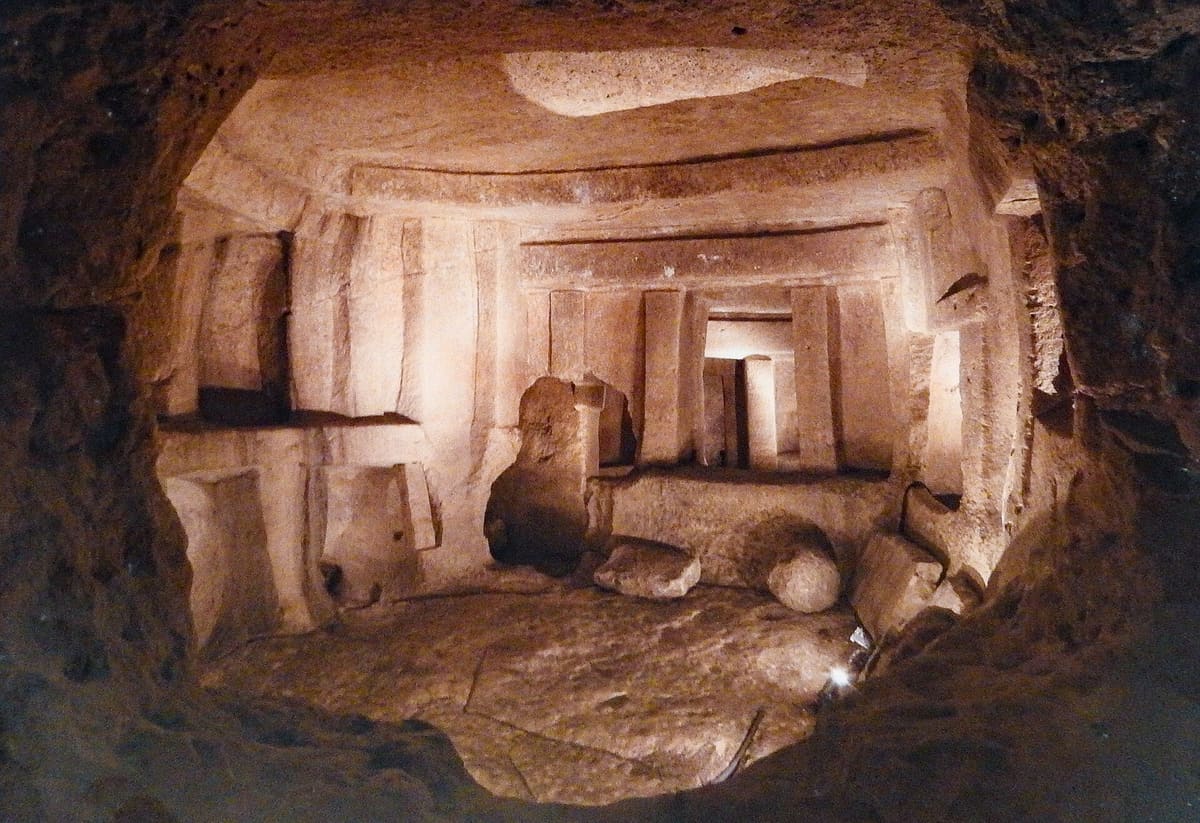
 xiquinhosilva / Wikimedia Commons, CC BY 2.0
- Established Peer-reviewed or mainstream consensus: the claim is as settled as archaeology gets.
- Suggestive Plausible and evidence-backed, but limited, evolving, or not yet mainstream.
- Contested Disputed among researchers, or popular-press overreach of what the evidence actually shows.
Beneath a quiet street in Paola, Malta, a staircase drops into the only known prehistoric underground temple on Earth. The Hal Saflieni Hypogeum was cut, level by level, into solid limestone beginning around 3600 BCE, using stone and antler tools. Three storeys of chambers, halls and passages were carved downward into the rock over centuries, and in one of them, the rock does something it should not.
It answers you.
The Oracle Room
One chamber, known as the Oracle Room, has a niche carved into its wall that behaves like an acoustic instrument. A voice pitched into it does not simply echo. It resonates, filling the whole space with a sound that seems to come from the stone itself. Visitors report feeling it in the chest as much as hearing it with the ears.
This is not mysticism, it is measurable. A rigorous peer-reviewed archaeoacoustic survey of the Hypogeum, published in Antiquity in 2017 by Robin Till, confirmed strong resonance behaviour in the chamber and documented its unusual acoustic properties. Established On-site measurements by Debertolis and colleagues found dominant resonance frequencies around 70 Hz and 114 Hz. Suggestive
Till, R. (2017), "An archaeoacoustic study of the &Ħal Saflieni Hypogeum on Malta," Antiquity 91(355) – author copy (Huddersfield); Debertolis et al. (~2014), "Archaeoacoustic Analysis of the &Ħal Saflieni Hypogeum" – ResearchGate.
The brain-frequency claim: what the evidence actually shows
Popular accounts of the Hypogeum often say that 110 hertz is “a frequency shown to affect the brain.” The claim has a real source, but it requires careful reading. A 2008 laboratory study by Cook, Pajot and Leuchter presented tones in the 110 Hz range to 30 participants via headphones and found a measurable EEG correlation. Suggestive
Cook, Pajot & Leuchter (2008), "Ancient Architectural Acoustic Resonance Patterns and Regional Brain Activity," Time and Mind 1(1): 95–104 – Taylor & Francis.
This is a small-sample laboratory study using headphones. It was not conducted at the Hypogeum. The jump from “a lab EEG study found a correlation with a headphone tone” to “the Hypogeum was engineered to alter human brain states” is not supported by the evidence. Contested Till’s rigorous 2017 survey explicitly declines to make that leap: the room is acoustically exceptional; whether that was deliberate design or a by-product of the carved limestone geometry is unknown. Watson and Keating’s foundational 1999 survey of megalithic acoustics made the same honest distinction: resonance is real; intentionality is not proven. Suggestive
Watson & Keating (1999), "Architecture and sound: an acoustic analysis of megalithic monuments in prehistoric Britain," Antiquity 73(280): 325–336 – aaronwatson.co.uk.
What is not in dispute: the Oracle Room has an acoustic character genuinely unlike most spaces, and standing inside it and speaking is a disconcerting experience. That is established. Why it is that way, and whether it was planned, is the open question.
A place built downward, and a burial site
The Hypogeum was also a burial place. The remains of an estimated seven thousand people were found within it, interred over a long period. Established It is so fragile that visitor numbers are strictly capped and the internal climate is controlled to protect the limestone and any residual ochre pigment on the walls. That combination, the intimacy, the cap on numbers, the silence, only adds to the sense of stepping somewhere that was designed for something specific, even if we no longer know precisely what.
Where the real places end and the story begins
The chambers, the carving, the resonance behaviour are all real and documented. The honest version of the acoustic story is, if anything, more interesting than the oversimplified one: a space that measurably does something unusual to sound, whose builders left no explanation of why they carved it this way.
Michael and Evelyn find something here that starts their journey, very early in the book. The novel imagines what it would mean if the acoustic properties were not a by-product but a purpose. The chamber that answers you is not invented. What the characters find inside it is.
Continue the trail
Get the complete Real Places field notes as a PDF now, plus each new site as it drops
All eight sites in one PDF: the full archaeology, the evidence tiers, the open questions. Yours the moment you join, then each new site as the series continues.
Never shared. Leave any time.Next site on the trail
The Sulawesi Caves
4.9° S, 119.5° E · Maros-Pangkep, Indonesia
Stolen Genesis: Legacy Denied is Book One of the Stolen Genesis series. The locations are real.