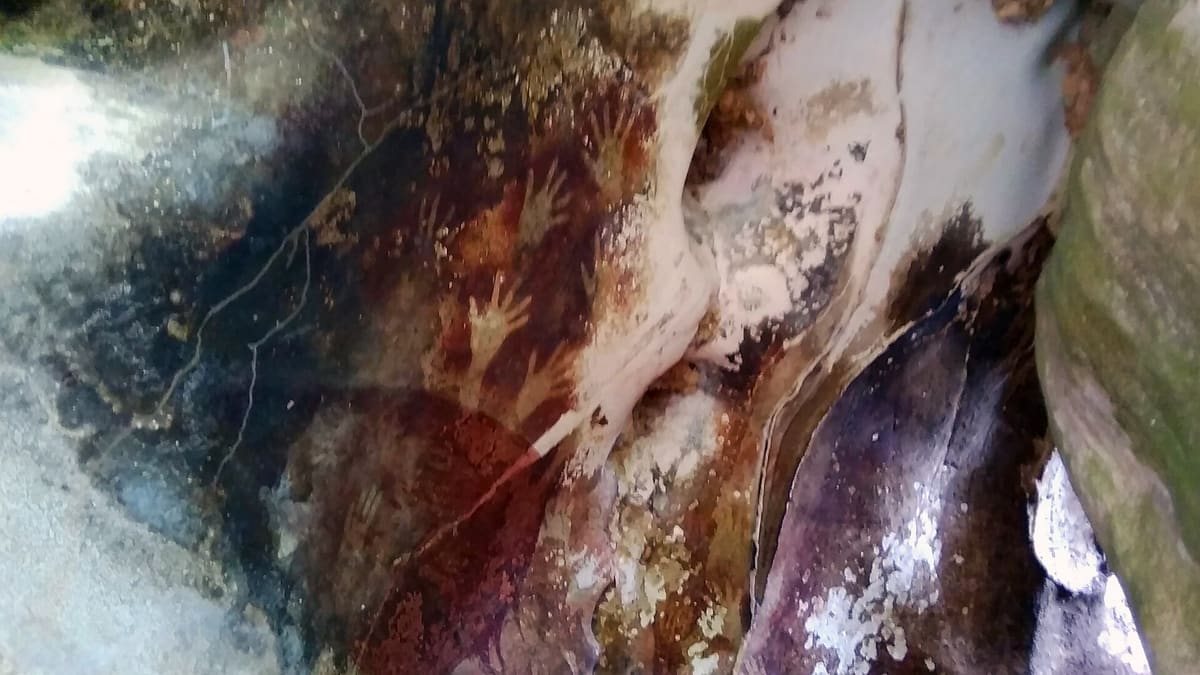
 Sabjan Badio / Wikimedia Commons, CC BY-SA 4.0
- Established Peer-reviewed or mainstream consensus: the claim is as settled as archaeology gets.
- Suggestive Plausible and evidence-backed, but limited, evolving, or not yet mainstream.
- Contested Disputed among researchers, or popular-press overreach of what the evidence actually shows.
In the limestone hills of Maros-Pangkep on the Indonesian island of Sulawesi, there are caves whose walls were painted so long ago that the dates keep breaking records faster than anyone can absorb them. Not abstract smears: hands, animals, and scenes of figures hunting. People were leaving deliberate, composed pictures here a thousand generations before the first city existed.
For a long time we assumed the cradle of art was Europe, the painted caves of France and Spain. Sulawesi quietly took that title away.
The dates: moving targets, all pointing the same direction
The numbers have shifted more than once, and honesty requires stating them with their proper caveats. All ages given by uranium-series dating are minimum ages: what is dated is a thin calcite crust that formed over the paint, so the art is at least as old as the date, and possibly older.
In 2021, a team led by Adam Brumm, Maxime Aubert and Adhi Oktaviana published the dating of a warty pig painting at Leang Tedongnge at a minimum of 45,500 years, at the time the oldest known representational art anywhere. Established
Brumm, Oktaviana, Aubert et al. (2021), "Oldest cave art found in Sulawesi," Science Advances – Science Advances; Griffith University release (2021) – Griffith University.
Then, in 2024, the same team published a revised uranium-series dating using a refined laser-ablation technique. A narrative scene at the cave of Leang Karampuang, showing human-like figures interacting with a wild pig, was re-dated to at least 51,200 years old. That makes it the oldest known figurative storytelling anywhere on Earth. Established
Oktaviana, Brumm, Aubert et al. (2024), "Narrative cave art in Indonesia by 51,200 years ago," Nature – Nature; Griffith University release (2024) – Griffith University.
Read that again. Composed storytelling, a scene with characters and an event, at least fifty-one thousand years ago. The qualitative claim is robust even if the specific figures continue to shift: Sulawesi holds the oldest known figurative and narrative art in the world, by a significant margin over the European cave paintings that long held the record.
A scene older than our species got comfortable
The Leang Karampuang painting is not abstract. It shows figures that appear human or human-like in active relationship with a large animal. That compositional decision, to show characters doing something together, is what makes it narrative rather than merely representational. Someone stood in that cave with a torch and ground ochre and thought about what a story looked like. They expected it to be understood.
The earlier warty pig at Leang Tedongnge, dated at least 45,500 years old, is also significant: it is a single animal rendered with enough detail to be identifiable as a species. These are not scribbles. The people who made them were artists in any meaningful sense of the word.
Hands on the wall
Alongside the figurative scenes are the hand stencils: a palm pressed to the rock, pigment blown around it, leaving a negative image that has outlasted everything else that person ever was. Established Thousands of years before the wheel, before agriculture, before metal, somebody reached out to the rock and left a mark that said, in the only way they could: I was here. We cannot read their language. We can read that gesture perfectly.
What the record does not tell us
Why these caves in particular, why these animals, why over such a long span of time, is unknown. The paintings are not clustered in one period: the caves were painted across many thousands of years, suggesting that this was not a single cultural moment but a long tradition. Whether the caves held ritual significance, whether the act of painting was itself the point rather than the end product, whether the images encode any narrative we could decode: all of these remain open. Suggestive
Where the real places end and the story begins
Everything above is documented and dated. The caves are real, the ages are published, the hands are still on the walls.
Michael and Evelyn find something here that starts their journey, very early in the book. The novel borrows the unnerving thing that is genuinely true about these caves: the proof that people we once called primitive were leaving careful, deliberate marks for a future they could not have imagined, and that we have only just learned to find them.
Continue the trail
Get the complete Real Places field notes as a PDF now, plus each new site as it drops
All eight sites in one PDF: the full archaeology, the evidence tiers, the open questions. Yours the moment you join, then each new site as the series continues.
Never shared. Leave any time.Next site on the trail
Glastonbury Tor
51.1444° N, 2.6984° W · Somerset, England
Stolen Genesis: Legacy Denied is Book One of the Stolen Genesis series. The locations are real.