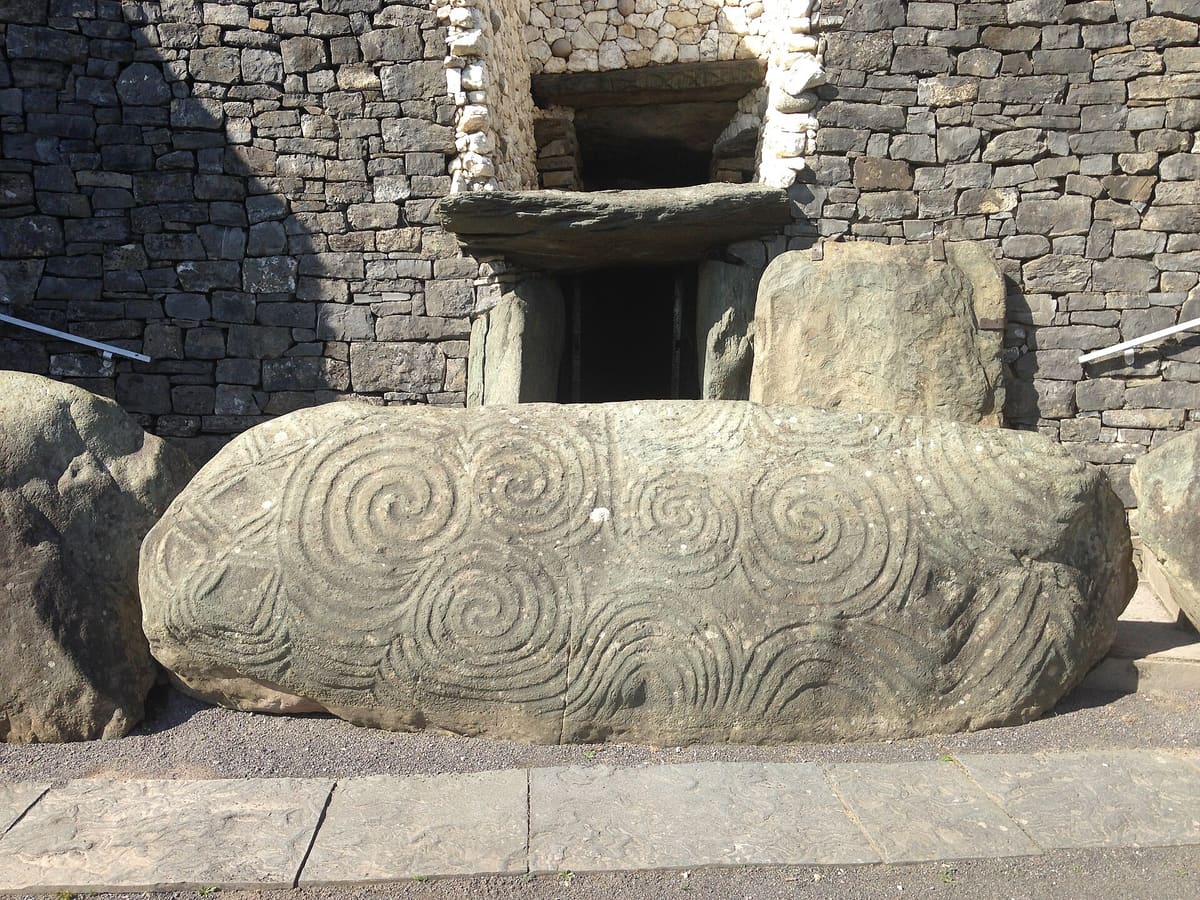
 Ceoil at English Wikipedia / Wikimedia Commons, CC BY-SA 3.0
- Established Peer-reviewed or mainstream consensus: the claim is as settled as archaeology gets.
- Suggestive Plausible and evidence-backed, but limited, evolving, or not yet mainstream.
- Contested Disputed among researchers, or popular-press overreach of what the evidence actually shows.
In the Boyne Valley in Ireland sits a great domed mound of stone and earth, built around 3200 BCE. That makes Newgrange older than the Great Pyramid of Giza and older than Stonehenge by roughly a thousand years. It is a UNESCO World Heritage Site and part of the Brú na Bóinne complex, the largest concentration of megalithic art in Europe. What the mound does on one morning a year is what makes it unforgettable.
The roof-box: precision astronomy in stone
Above the entrance, the builders left a deliberate slot in the stone, now called the roof-box. For most of the year it does nothing. But in the days around the winter solstice, the rising sun aligns with that slot and sends a narrow beam of light down the nineteen-metre passage, reaching the floor of the chamber at the very centre of the mound. The light event lasts for several minutes on the mornings closest to the solstice. Established
Hensey, R. (2017), "Rediscovering the Winter Solstice Alignment at Newgrange," in The Oxford Handbook of Light in Archaeology, OUP – newgrange.com (PDF); O’Kelly excavation (1962–75); roof-box found 1963, first observed illumination 21 Dec 1967 – RTÉ Brainstorm.
The roof-box was discovered by excavator Michael J. O’Kelly in 1963 and its purpose confirmed on the morning of 21 December 1967, when O’Kelly stood alone inside the chamber and watched the sun fill it for the first time in modern memory. This is not a happy accident. It is a piece of precision astronomy and engineering executed more than five thousand years ago by people without writing or metal, who understood the movement of the sun well enough to freeze a single sunrise into architecture.
One caveat is worth noting: because of the gradual drift in the Earth’s axial tilt over five millennia, the alignment is not as tight today as when Newgrange was built. The light now enters a few minutes after technical sunrise, and the event plays out over several mornings rather than one precise moment. Contested Popular descriptions that say “at dawn on exactly the winter solstice” are a slight simplification of the nuanced modern picture.
The triple spiral and the megalithic art
The great kerbstone at the entrance carries the famous Newgrange triple spiral, three interlocking coils of unknown meaning cut deep into the rock. The same motif appears on stones inside the chamber. Newgrange holds the largest and most elaborate programme of megalithic art in Europe, and the triple spiral found here is essentially unique to this monument. Established
UNESCO WHC "Brú na Bóinne" (inscribed 1993) – whc.unesco.org; OPW World Heritage Ireland – worldheritageireland.ie.
The spiral predates the Celts by roughly two and a half thousand years. It is a common error to associate it with Celtic tradition, but the monument and its carvings are from a culture that preceded any Celtic presence by millennia. What the spiral meant to the people who carved it has not been recorded and is not known. It is present on the most important stone at the most precisely engineered monument in prehistoric Ireland, and that is all we can say with confidence.
What the reconstruction got right and what it invented
The gleaming white-quartz facade that visitors see today is O’Kelly’s 1970s reconstruction. Quartz was genuinely found at the site in large quantities, but whether it originally formed a vertical wall or lay spread in front of the mound as a forecourt surface is debated among archaeologists. Contested The reconstruction gives a dramatic visual impression that may or may not match the original appearance.
Similarly, a claim made in 2016 by historian Michael Gibbons that the roof-box was a modern fabrication was firmly rejected by the mainstream: early-twentieth-century photographs predating O’Kelly’s excavation show the roof-box opening in place, confirming it is original. Established
Roof-box controversy rebuttal – Shadows and Stone.
What remains genuinely open
Why the alignment was built is not known. Astronomical ability is clear; intent is inferred. Whether the chamber was primarily a tomb, a ritual space, or something else is debated. The acoustic properties of the chamber have been noted in archaeoacoustic surveys, with some evidence for standing-wave resonance at low frequencies, though there is no basis for claiming deliberate acoustic design. Suggestive
Watson acoustic survey – aaronwatson.co.uk.
Where the real places end and the story begins
The mound, the solstice beam, the spirals: all real, all there, you can apply for a winter solstice ballot to stand inside it at dawn.
Michael and Evelyn find something here that starts their journey, very early in the book. The novel imagines what it would mean if the precision and the repeated spiral were not independent choices but a single inherited impulse. The unsettling fact underneath it, that these places were engineered with an obsessive, repeated precision we still cannot fully explain, is exactly true.
Continue the trail
Get the complete Real Places field notes as a PDF now, plus each new site as it drops
All eight sites in one PDF: the full archaeology, the evidence tiers, the open questions. Yours the moment you join, then each new site as the series continues.
Never shared. Leave any time.Next site on the trail
Hal Saflieni Hypogeum
35.8727° N, 14.5046° E · Paola, Malta
Stolen Genesis: Legacy Denied is Book One of the Stolen Genesis series. The locations are real.